Showing posts with label Radicalized Terrorism. Show all posts

Sunday, June 19, 2016

Combatting Violent Extremism

The fight against violent extremism is being fought by a shift in global consciousness resulting in a collective effort by governments, NGOs and stakeholders, including individuals at the local level. Radicalized extremism, which has nothing to do with religion, is an ideology founded on inducing fear of imagined or future danger. It is a feeling, not an action.  Simply stated, extremism is psychological warfare.
The effectiveness of any extremist act is not the act itself, but the extent of the fear evoked in the general public.  The public’s apperception of fear is a miscalculation as the attack has already occurred and the likelihood of being personally involved in a future attack is less than negligible. In turn, we subconsciously transfer our fear to the Muslim population giving rise to widespread bigotry and hatred.  We have permitted the real battleground to be a mental schema that we have been conditioned to experience for more than fifteen years.
What are we so afraid of? 
The U.S. Department of State defines extremism as "…premeditated politically-motivated violence perpetrated against non-combatant targets by sub-national groups or clandestine agents, usually intended to influence an audience.”
Violent attacks are staged by radicalized extremists to maximize publicity.  For instance, attacks are often scheduled for Friday mornings triggering a seemingly nonstop barrage of sensationalized weekend media reports.  
Targets are chosen to not only symbolize what extremists oppose but, also those which will generate the most media coverage and public sympathy. Sympathy was the motive behind November 13, 2015 Paris attack on a nightclub frequented by young people and at an international sporting event, and the June 12, 2015 attack on a gay bar was in Orlando, America’s favorite family destination.  Recent examples of acts based on opposition were the March 22, 2016 Brussels attacks, which came days after the Belgium arrest of the last known suspect in the Paris attack, and the January 7, 2015 Paris Charlie Hebdo attack in objection to its re-publication of the Jyllands-Posten cartoons of Muhammad.  
Other more random attacks are undertaken by individuals with no identifiable nexus to extremist leaders even though the attackers claim allegiance to the ideology, as was the case in the December 2, 2015 San Bernardino shooting.
Regardless of the motive, the result is an "An anxiety-inspiring method of repeated violent action, employed by (semi-) clandestine individual, group or state actors, for idiosyncratic, criminal or political reasons, whereby - in contrast to assassination - the direct targets of violence are not the main targets”; the United Nations’ 1992 definition.
The target is you, the general public.
By the Numbers
The chance of a Westerner being killed by a violent extremist act is exceedingly low: about a one in three million each year.
Between 9.11 and 2013, foreign-inspired violent acts of extremism only claimed two dozen lives in the United States. Globally, the U.S. Department of State reported that, in 2011, only 17 U.S. civilians were killed worldwide by extremists, including deaths in all theaters of war.
The 2011 Report on Terrorism from the National Counter Terrorism Center stated that Americans are as likely to be “crushed to death by their televisions or furniture each year” as they are to be killed by an extremist.   As one Washington Post headline read, “You’re more likely to be fatally crushed by furniture than killed by a terrorist”.
Abandoning the Schema
In a recent statement, President Barack Obama stated:
“Groups like ISIL and al-Qaida want to make this war a war between Islam and America, or between Islam and the West. If we fall into the trap of painting all Muslims as a broad brush, and imply that we are at war with the entire religion, then we are doing the terrorists’ work for them.
But we are now seeing how dangerous this kind of mind-set and this kind of thinking can be. We are starting to see where this kind of rhetoric and loose talk and sloppiness about who exactly we are fighting, where this can lead us. This is a country founded on basic freedoms, including freedom of religion. We don’t have religious tests here. Our founders, our Constitution, our Bill of Rights are clear about that.
And if we ever abandon those values, we wouldn’t only make it a lot easier to radicalize people here and around the world, but we would have betrayed the very things we are trying to protect, the pluralism and the openness, our rule of law, our civil liberties, the very things that make this country great, the very things that make us exceptional.
And then the terrorists would have won. And we cannot let that happen.”
How, Why and Where Radicalization Transpires
According to John Horgan, PhD, Director the Pennsylvania State University's International Center for the Study of Terrorism, people who are predisposed to extremist recruitment and radicalization tend to:
  • Feel angry, alienated or disenfranchised;
  • Believe that their current political involvement does not give them the power to effect real change;
  • Identify with perceived victims of the social injustice they are fighting;
  • Feel the need to take action rather than just talking about the problem;
  • Believe that engaging in violence against the state is not immoral;
  • Have friends or family sympathetic to the cause; and
  • Believe that joining a movement offers social and psychological rewards such as adventure, camaraderie and a heightened sense of identity.
Mosques Are Not Enclaves for Terrorist
Loners by nature, “More than 80 per cent who join the Islamic State do so through peer-to-peer relationships, mostly with friends and sometimes family. Very few join in mosques or through recruitment by anonymous strangers… radicalization rarely occurs in mosques,” stated Scott Atran, co-founder of the Center for the Resolution of Intractable Conflict at Oxford University.
Charles Kurzman, a professor of sociology at the University of North Carolina at Chapel Hill, co-author of a 2010 report "Anti-Terror Lessons of Muslim-Americans", also found that, “Very few of these [extremist] individuals are regular participants at American mosques. In fact, in a number of cases they have expressed hostility toward their local religious leaders. Unfortunately, it seems to be a pattern that these individuals engaged in violent extremism move away from the mosque as they become radicalized and are interacting less with the religious leaders who preach peace.”
The Islamic Community
The American-Muslim community has publicly and privately denounced terrorism and violence, is willing to report radical individuals to law enforcement, and encourages community building and political engagement.
A 2010 study conducted by Duke University and the University of North Carolina at Chapel Hill determined that these programs are an effective deterrent to radicalization.  That study also found that “48 of the 120 Muslims suspected of plotting domestic terrorist attacks since Sept. 11, 2001, were turned in by fellow Muslims, including parents, mosque members and even a Facebook friend.”
Mosques around the world have created programs to engage vulnerable youth to prevent radicalization by the rampant extremist propaganda, easily accessed on social media.  Countering radicalization has been a topic in sermons and at national conferences. 
When ISIS emerged, the world's most prominent Muslim leaders and scholars published an open leader to ISIS leader Abu Bakr al-Baghdadi renouncing the militant group's religious claims, including that of the Caliphate.
Yet, despite its best efforts, the Muslim community is so stigmatized that after the Paris attack the hashtag #NotInMyName emerged on social media.
The Media’s Role
First and foremost, the media’s disproportionate focus on Western acts of terror reinforces such mistaken perceptions. “Extremely vivid image[s] of death and damage” resulting from terrorist attacks are “reinforced by media attention and frequent conversation,” leaving us with highly accessible memories of such events, stated Daniel Kahneman, Professor Emeritus at Princeton University.
For instance, CNN International, six days after the Orlando shooting, was still displaying headline “Terror in Orlando”, fostering the apperception that there exists cause for fear of another and imminent attack.
“When people who have been exposed to such coverage later assess how likely more terrorism is, such events come readily to mind — and so they are likely to assign probabilities biased upward,” stated former Pentagon official Andrew Shaver.
Second, by engaging in nonstop and repetitive reporting the media is acting as ade facto public relations department for extremist organizations.  Media must shift its focus from repeatedly showing videos of attacks to the courage and solidarity exhibited by first responders, the community, surviving family and friends, and committed law enforcement officials.
Consider that just one additional New York Times article about an attack in any country increased the probability of ensuing attacks in that country by between 11% and 15%. On average, that additional NYT article results in between one and two casualties from another attack within the next week.
Fourth, the question is always posed of a government official or expert, “What could the government have done to prevent this attack?”  After a brief pause, the interviewee utters something vague. 
Take for example the attack on the Brussels airport.  Over and over again, reporters asked officials what they could have been done to prevent the attack.  One “expert’ opined that security should have been moved outside of the building.  The reality is that all this would have accomplished is moving the queue to another location.  The correct answer is there was probably nothing that could have been done to prevent that attack. 
With an increasing number of “homegrown” extremists, there is even less intelligence available to thwart attacks.
Yet, for days after an attack line of questioning continues when the focus in the aftermath ought to be on the inherent strength and resiliency of Western communities and the good work done by law enforcement officials.
Fifth, the word choices made by the news and entertainment industries are often inflammatory.  For instance, the term “suicide bomber” is almost always used as opposed to the more accurate term “homicidal extremist”.  Continuous headlines such as “Terror in Orlando”, rather than “Solidarity in the Midst of Tragedy” or “Law Enforcement Responded With Flying Colors”, not only sends the wrong message to the public but furthers extremist objectives. 
Sixth, oftentimes, the reporting is inaccurate.  For instance, after the November 2015 Paris attack, CNN’s Wolf Blitzer reported that the “Caliphate” was responsible.  ISIS’ claim that its leader is the Caliphate, or a prophet sent by God to provide just governance for all of Islam, could not be farther from the truth.  But, given Mr. Blitzer’s credibility, the public readily believe what he says.
To successful combat violent extremism responsible journalism is essential.
Donald Trump is Even More Culpable
As the presumptive Republican presidential candidate Donald Trump ought to be upholding the principles so carefully articulated by the United States’ founding fathers in the Constitution.  Rather, he actively promotes hatred and bigotry giving rise to violent and large protests at his public appearances.
Oddly, political commentators seem to have no knowledge of the Fighting Words Doctrine, which the United States Supreme Court in 1942 held to be a limitation that freedom of speech protected by the First Amendment.  In a unanimous decision, Chaplinsky v. New Hampshire, the High Court held that "insulting or 'fighting words,' are those that by their very utterance inflict injury or tend to incite an immediate breach of the peace".  Can there be any doubt that Mr. Trump’s remarks rise to the level of fighting words?
On Monday, June 13, 2016, Mr. Trump added to the plethora of anti-Muslims statements when he promised that, if elected, he would "suspend immigration from areas of the world when there is a proven history of terrorism against the United States, Europe or our allies, until we understand how to end these threats." Perhaps Mr. Trump should learn about the International Declaration of Human Rights, the Geneva Conventions and the Convention and Protocol Related to the Status of Refugees, which grants individuals the right, under international law, to seek political asylum.
Mr. Trump further stated that, if president, he would insure that mosques were monitored.  Apparently, he has not read the research.  In the wake of 9/11, after more than six years of spying on Muslim neighborhoods, eavesdropping on conversations and cataloguing mosques, the New York Police Department's secret Demographics Unit never generated a lead or triggered a terrorism investigation.
As President Obama stated, “We now have proposals from the presumptive Republican nominee for president of the United States to bar all Muslims from immigrating into America. We hear language that singles out immigrants and suggests entire religious communities are complacent in violence.”
Combatting Violent Extremism
“Violent extremists are not a new threat; they have raged against civilization as long as we have tried to build it. What is new is how the United States and our partners around the world are pushing them back – with a more comprehensive, preventive, and civilian-centered approach we call Countering Violent Extremism, or CVE,” stated Sewall, Sarah, Unite States Under Secretary for Civilian Security, Democracy, and Human Rights.
As explained by The International Centre for Counter-Terrorism – The Hague, “CVE programmes include an astonishing range of activities, from messaging to community outreach, to religious argumentation, to economic development. Programmes proposed under the rubric of CVE can range from individual interventions to efforts to rewrite the script for entire societies, from the economy to social mores.”
Richard Stengel, U.S. Under Secretary of State for Public Diplomacy and Public Affairs, stated that efforts against extremism should focus “not only countering their message, but creating a positive alternative for people who may be attracted to their message”.
Thus, CVE has two overlapping goals:
  • Disengagement to dissuade individuals from violent participation in and material support for violent extremist organisations and movements.
  • De-radicalization/counter-radicalization to dissuade individuals from adopting extremist ideologies.
The global movement behind these goals includes the RESOLVE network brought about in February 2014 at the White House Summit on Countering Violent Extremism, which launched a comprehensive CVE effort that now encompasses over 100 countries, 20 multilateral bodies, and 400 civil society organizations.
As a result, foreign governments are developing CVE strategies providing meaningful roles for those outside government.
According to Ms. Sewall, “Many of those actors – like young people, mayors, and women – have launched their own global networks to learn from each other’s experience countering violent extremism in their communities.”
What Can You Do?
Get involved at the local level with CVE initiatives. A list of resources can be accessed at https://www.dhs.gov/publication/countering-violent-extremism-resources.
Write to the media to express your concerns, refuse to watch inflammatory programming, have the self-control to know when “enough is enough” and the wisdom to understand that what is real and what is fiction.
For those of us in the European Union and the United States, we must exercise our right to vote for politicians who respect national and international law, and who promote harmonious and peaceful relationships among diverse populations and governments.
Write or petition school and government officials to offer compulsory education. “Without anti-racism education, war will continue to prevail and peace will continue to be what it is; a falsehood that distracts the world populace from the reality on the ground... Otherwise, we will continue to have the rise of terrorist states,” stated Ahmad Moussa, a Palestinian-Canadian professor and author.
Participate in global interfaith activities to learn more about not just the Islamic faith but, other faiths that differ from your own.  Most people are unaware that the three major world religions, Christianity, Judaism and Islam all share a common belief in Jesus.
We can open our minds and hearts to the moderate Muslim populations in our communities.  For instance, many mosques and Islamic community centers host programs that are open to the general public.  Attending events will reduce conditioned fear.
We should also be diligent in reporting activity that we feel is suspicious.  It’s better to be safe than sorry.
The bottom line is that we can all participate in the war on extremism.
"The only way to change the world is to change the story," stated Llewellyn Vaughan-Lee, Sufi teacher and scholar.
About the Author
Cynthia M. Lardner is a journalist focusing on geopolitics.  Ms. Lardner is a contributing editor for Tuck Magazine and E – The Magazine for Today’s Executive Female Executive, and her blogs are read in over 37 countries.  As a thought leader in the area of foreign policy, her philosophy is to collectively influence conscious global thinking. Ms. Lardner holds degrees in journalism, law, and counseling psychology.
Sources
Berger, J.M. “Making CVE Work: A Focused Approach Based on Process Disruption”, The International Centre for Counter-Terrorism – The Hague 7, no. 5 (2016), as found on the www at http://icct.nl/wp-content/uploads/2016/05/J.-M.-Berger-Making-CVE-Work-A-Focused-Approach-Based-on-Process-Disruption-.pdf.
Boehlert, Eric, "Pushing For Mosque Surveillance, Fox News Is Fighting The Last War", June 16, 2016, Media Matters for America, as found on the www at https://mediamatters.org/blog/2016/06/16/pushing-mosque-surveillance-fox-news-fighting-last-war/210989.
Doward, Jamie, "Media coverage of terrorism ‘leads to further violence’", August 1, 2015, The Guardian, as found on the www athttp://www.theguardian.com/media/2015/aug/01/media-coverage-terrorism-further-violence.
Horgan, John. "Walking Away from Terrorism" (Routledge, 2009).
"How the U.S. is countering the Islamic extremist propaganda machine", June 16, 2016, PBS Newshour, as found on the www athttp://www.pbs.org/newshour/bb/how-the-u-s-is-countering-the-islamic-extremist-propaganda-machine/.
Moussa, A., The Islamic State and the Jewish State, October 17, 2014, Counterpunch, as found on the www athttp://www.counterpunch.org/2014/10/17/the-islamic-state-and-the-jewish-state/.
Sewall, Sarah, "Countering Violent Extremism: How Human Rights and Good Governance Help Prevent Terrorism", February 29, 2016, United States Department of State, as found on the www at http://m.state.gov/md253870.htm.
Shaver, Andrew, “You’re more likely to be fatally crushed by furniture than killed by a terrorist”, November 23, 2015, Washington Post, as found on the www athttps://www.washingtonpost.com/news/monkey-cage/wp/2015/11/23/youre-more-likely-to-be-fatally-crushed-by-furniture-than-killed-by-a-terrorist/.

Tuesday, December 8, 2015

As Tensions Mount: Türkiye


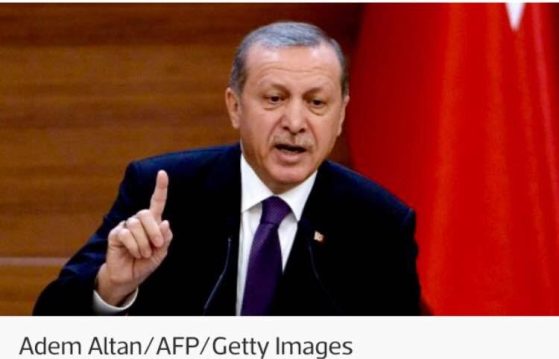
TU,erdogan
By:       Cynthia M. Lardner
Introduction
As the geopolitical tensions in the world continue to mount, Türkiye holds a pivotal role both geographically and politically.  This paper explores the morass of on-going situations in the context of complex diplomatic relationships with Russia, NATO, the European Union and coalition forces fighting in neighboring Syria, as well as internal issues arising primarily out of factional religious groups.
Governance
The Prophet Muhammad “…institutionalized the “doctrine of “One Ruler, One Authority, One Mosque”, giving rise to the title of “Caliphate”[i].   The Prophet Muhammad taught that the Caliphate is a God’s heaven sent Prophet to lead of all of Islam under a just system of governance.
‘“[S]ecularization of Türkiye started in the society during the last years of Ottoman Empire “the caliphate—the supreme politico-religious office of Islam, and symbol of the sultan’s claim to world leadership of all Muslims—was abolished[ii].””
Rejecting both a Caliphate[iii] and Sharia law, in 1921, Türkiye became a secular state; a parliamentary democracy[iv].  In 1982, Türkiye updated its governing document, the Constitution of the Republic of Türkiye.  A constitution is a contract between the people and its government.  The foundation of Türkiye’s constitution is laïcité, under which there is social and legal equality, democratic governance, and freedom of thought, expression and religion. 
As of 2008, Türkiye was 70-75% Turkish, 19% Kurdish, and 7-12% minorities, including Jews.  Kurds in Türkiye number 10-20 million. There are also 65,000 Armenian Orthodox Christians, 25,000 Jews, and less than 3,000 Greek Orthodox Christians.[v].  
Türkiye passed enabling laws criminalizing hate crimes.  Over the years, these laws have been decreasingly enforced[vi], especially as to its Kurdish and Jewish populations[vii].  Its historical Ottoman Anti-Semitic prejudices have crossed international borders, including the cessation of diplomatic ties with Israel[viii]
For the first time in 13 years during elections held in June 2015 President Recep Tayyip Erdoğan’s Justice and Development Party (AKP), which he founded in 2001, lost its parliamentary majority.  Mr. Erdoğan responded by calling for a referendum election in November 2015 after which the AKP narrowly reclaimed its majority in parliament[ix].
The Kurds
The Kurds or کورد‎ are a Middle Eastern ethnic group, numbering 40 million worldwide; a majority of whom inhabit a contiguous area including parts of Iran, Southeastern Türkiye and Northern Syria, with the later also known as Western Kurdistan or Rojava. Kurds are overwhelmingly Muslim with the majority of Sunni descent[x].  The Kurds are so closely related to Iranian culture and linguistics that they themselves call themselves Iranian[xi]
Much of the divisiveness in Türkiye stems from long term hostilities between the AKP and the Kurds, who, like the Palestinians, want a separate Kurdish state[xii], perceived as an on-going threat by Türkiye’s government.
“Since the creation of the Turkish state in 1923, the Kurdish people have suffered egregious human rights abuses from Ankara [the Turkish capital] – from massacres to the denial of their very existence as a race[xiii].” 
In recent times, a 1984 separatist insurgency by the Kurdistan Workers' Party (PKK), now known as the Kurdistan People's Congress or Kongra-Gel (KGK), claimed more than 30,000 lives.  After the 1999 capture of the group's leader, they withdrew from Türkiye; with some Kurds going to northern Iraq and others to Syria[xiv].  
Exodus to Syria
Exodus to neighboring Syria has occurred at several junctures in Turkish history, starting in 1925[xv].  Following the 1962 Census, the government claimed that the Kurds were illegal Turks and Iraqis residing in Syria. Over 120 000 Kurds or 40% of the Syrian Kurd population were stripped of their Syrian citizenship, deprived of passports to leave, and the Kurdish language and other cultural expressions banned[xvi].
Stripped of their nationality, these now stateless Kurds were still subjected to conscription in the military for a government they no longer supported.  Over the last decade, the Kurds have had a different agenda in Syria; the creation of a separate Kurdish state[xvii].” 
“Türkiye has been watching the growing strength of the Kurdish rebels’ armed offshoot, the YPG, across the border in Syria. The YPG has taken the lead in the fight against the Islamic State, driving its fighters from a number of border areas. In the process, it has captured territory next to Türkiye’s southern border, creating a semiautonomous region[xviii].”  This has heightened insecurity within the AKP.
The Remaining Turkish Kurds
Kurds remaining in Türkiye never improved their position[xix]. They live in a concentrated Southeastern area.  It is “[a] strategic location controlling the Turkish Straits… that link the Black and Aegean Seas; Mount Ararat, the legendary landing place of Noah's ark[xx].
President Erdoğan has engaged in the ethnic cleansing and genocide of the Kurds, both in and outside of Türkiye[xxi].  Ethnic cleansing and genocide, collectively known as Scientific Racism, is a crime against humanity[xxii].  Over the last 30 years, 40,000 individuals have lost their lives in Turkish-Kurdish clashes[xxiii].
Parallel State
Based on the internal conflicts, President Erdoğan has been further accused of manipulating Türkiye into a ‘parallel state’:
"“Parallel state”, “deep state”, and “parallel structure” are terms all too familiar to the Turkish public. This dual state structure was developed after the 1960 coup and further strengthened by the 1982 constitution. The division is composed of two components: The first is the elected, accountable, visible and civilian government; while the second, an unelected, unaccountable and invisible structure embedded in high bureaucracy with affiliates in media and big business[xxiv]."
President Erdoğan may find regional success[xxv] among some Muslims and the ruling elite in Saudi Arabia and Kuwait.  Regional support neither creates the global relationships needed to sustain peace nor the international commerce and financial support needed to sustain its diverse and divided people.
Relationship with the West
In 1945 Türkiye joined the United Nations.  In 1952 it became a NATO member nation. In 1963, Türkiye was afforded associate member status in the European Community. 
Accession talks with the European Union (EU) began in 2005.  During this period sweeping economic reforms contributed to economic expansion[xxvi] resulting in over 13,000 EU companies, backed by foreign investment, operating in Türkiye.  Nonetheless, it was denied EU member state status.
“It has been kept at arm's length - partly because of fears of mass migration from a Muslim country. President Erdoğan, in his early days of power as prime minister, was very keen on forging ahead with a full relationship - but Austria, France and Germany made it clear it was unlikely Türkiye would ever be allowed in[xxvii].”
The Beginning of a Shift in Foreign Policy
Türkiye was accused as being the main passageway for radicalized terrorists[xxviii] traveling between Europe and Syria[xxix] and for supplying the radicalized terrorists with weapons, used to attack Kurds in Rojava[xxx].”
Mr. Erdoğan’s “dealings with the ISIS are unacceptable…Türkiye has also allowed weapons to be transported into Syria through its borders. Also that the ISIS has been able to sell its oil via Türkiye is extraordinary… President Erdoğan’s government is “pursuing a “murky” policy in Syria”, and NATO must force Türkiye, a NATO member to cease its support of ISIS and shift its policy toward the Kurdistan Workers’ Party”, stated Claudia Roth, Germany’s Deputy Speaker[xxxi], in late 2014.
This precipitated a December 10, 2014 European Union visit with the objective of convincing Türkiye to fight with the Kurds against and no longer align with the radicalized terrorists[xxxii].
By January 2015, Türkiye’s relationship with the radicalized terrorists was strained.  Nonetheless, “…ISIS has garnered significant domestic support, as proven by reports of jihadi cells and hospitals operating in Türkiye… and the thousands of Turkish foreign fighters in Syria[xxxiii].”
On July 24, 2015, under pressure from coalition member nations, many of which it engages in significant trade, Türkiye joined the American led coalition forces[xxxiv].  In October 2015 U.S. jets were given access to Türkiye’s Incirlik Air Base from which air strikes could be carried out more efficiently.
Türkiye’s Syrian Target
The problems has been and is that Mr. Erdoğan considers the Kurds an even greater threat to the AKP than ISIS[xxxv].  This has led to allegations that Türkiye’s military actions have focused on the Kurds, with the objective of preventing the neighboring portion of land under Kurdish control from expanding, when those same Kurds are the only ground troops acting in corroboration with coalition forces[xxxvi].
The fact is that ISIS could rapidly be destroyed if Kurdish forces in Syria and Iraq — along with Kurdish guerillas in Türkiye — were fully unleashed. They have proved extraordinarily militarily effective and oppose every aspect of Isis’s devilish ideology.
Yet this does not happen because PKK forces in Syria and Kurds in northern Iraq are under continual bombardment by the Turkish air force. No, the fact is that while Türkiye may be a member of NATO — and of the alliance taking on the jihadists — Erdoğan seems to be doing almost everything he can to cripple the forces actually fighting ISIS.
But then Erdoğan has always been utterly ruthless when it comes to protecting his own interests[xxxvii].
`This is inconsistent with Türkiye’s obligations as a NATO member nation[xxxviii]
Enter Russia
On September 30, 2015 Russia entered the Syrian War[xxxix]. Having not aligned with coalition forces, Russia quickly came under intense criticism by the coalition forces that it was striking targets inconsistent with and impeding the concerted military objectives of the coalition forces.
Then Russian President Vladimir Putin, at the November 15-16, 2015 G20 summit in held in Türkiye, indirectly accused Türkiye of financing the radicalized terrorists.  A week later, on November 24, 2015, a Russian fighter jet was shot down by the Turkish Air Force without provocation or compliance with required military protocols[xl]
This sparked allegations by Mr. Putin that Türkiye was transporting and selling oil on behalf of the radicalized terrorists.  Mr. Erdoğan responded by making the same allegations against Moscow[xli].
As diplomatic relations between the two countries grinded to a standstill, on November 25, 2015, to no avail, NATO Secretary General Jens Stoltenberg called upon Russia and Türkiye to reduce the escalating tensions between them.
Russia’s response was to strengthen its Syrian anti-aircraft defences; to introduce a wide range of economic sanctions against Türkiye, and to suspend visa-free travel between the two countries[xlii].
Syria is now the battleground for a proxy war between two regional powers, Russia and Türkiye, or more particularly between their ego-fueled presidents: Recep Erdoğan and Vladimir Putin. Or, if you like, between the Sultan and the Tsar.
These two men, driven by their own imperial ambitions, have no intention of seeking peace in Syria, except on their own terms. It is already an international conflict sucking in fighters from Iran, Saudi Arabia, Qatar, Chechnya and Pakistan, plus Shia from Iraq and Lebanon, and now it threatens to drag in Nato. It is no exaggeration to say the conflict has the potential to become a Third World War.
Not that continuing stalemate is the main threat here – the proxy war in Syria is bringing the real risk of escalating into a disastrous, and open, conflagration[xliii].
From this point on diplomatic relations between Russia, Türkiye, the EU and the coalition forces have all suffered to varying degrees. Even though the U.S. has held firm that it would not be sending ground troops to Syria, Moscow nevertheless warned against such a development, going so far as to state that such action could lead to a Third World War[xliv].
The Refugee Crisis
Set against mounting geopolitical tensions between first Russia and Türkiye, which rapidly spread to the rest of the Western world, is the Syrian refugee crisis.  The numbers are staggering: there are presently 4.7 million Syrian refugees of which 2.6 million are in Türkiye alone, and half of them are children[xlv].  Türkiye’s has earned good marks from the UNHCR for its handling of this humanitarian crisis[xlvi], for which it has expended 8.5 billion dollars[xlvii].
Türkiye, along with Greece, are the two primary entry points for refugees seeking to travel to other European countries. This has sparked widespread concern and disagreement by the EU member nations; with many stating that they no longer have the capacity to take in more refugees; others closing their borders[xlviii] and some instituting small daily quotas.  
The stark reality is that the bulk of the expense had been born by Türkiye.  Now, with the destruction of Aleppo, minimally another 80,000 refugees wait just inside the Syrian border hoping to gain entry into Türkiye. 
Not wanting more refugees, along with visa free travel for Turkish nationals, the EU pledged 3 billion dollars in immediate aid to assist the refugees in Türkiye[xlix].  When those funds were not made immediately available, Türkiye threatened to open its borders and allow the refugees passage into the EU[l]. Now, it appears that those funds will be disbursed; with every EU member nation having been allocated a prorated share[li].  Türkiye’s response was that a single payment was insufficient and that it expects additional financial support from the EU.
Following several recent terrorist acts in Europe, with the suspects having been identified as arriving amidst the refugees, to appease growing fears, NATO issued a statement that it would provide reconnaissance air and watercraft as to boats approaching Greece to gather intelligence as to any suspected terrorists[lii].  The appearance of NATO has only increased geopolitical tensions with Russia, which has disdained NATO since its 1949 creation.
About the Author
Cynthia M. Lardner holds a journalism degree, she is an attorney, and has trained as a therapist. As a thought leader, her philosodnotphy is to collectively influence conscious global thinking understanding that everything and everyone is subject to change given the right circumstances; Standard Theory or Theory of Everything.
She is currently looking for a challenging position that will fully utilize her collective skill set.  She is particularly interested in foreign policy and social justice.
Endnotes
[i] Crooke, A., “You Can’t Understand ISIS If You Don’t Know the History of Wahhabism in Saudi Arabia,” August 27, 2014, The Huffington Post, as found on the www at http://m.huffpost.com/us/entry/5717157.
See also “What’s the appeal of a caliphate?”, October 24, 2014, BBC News Magazine, as found on the www at http://m.bbc.com/news/magazine-29761018; Cordal, S., “How ISIS Governs Its Caliphate:, December 2, 2014, Newsweek, as found on the www at http://www.newsweek.com/2014/12/12/how-isis-governs-its-caliphate-288517.html.
[ii] Konda, Research and Consultancy, “Religion, Secularism and the Veil in daily life”, September 8, 2007, Milliyet, as found on the www athttp://www.angelfire.com/az/rescon/ALEVI.html.
[iii] On December 3, 2015, Mr. Putin stated, "…probably Allah alone knows why they did it.  And evidently Allah decided to punish the ruling clique in Turkey, by depriving it of any reason or logic.  Putin: Turkey 'will regret' downing Russian bomber in Syria, December 3, 2015, BBC News, as found on www at http://www.bbc.co.uk/news/world-europe-zone (Mr. Putin distinguished between the elite Turkish leadership and Russia's "many longstanding and reliable friends in Turkey".).
This statement may have been issued in response to scattered news items that Mr. Erdoğan proclaimed himself to be the next Caliphate. For instance, in late October 2014, President Erdoğan stated it was his “grand design to recreate the Ottoman caliphate with the help of the Sunni jihadist army.” Dettmer, Jamie, "Critics, Even Supporters Say: Erdoğan is the Man Who Would Be Caliph", October 27, 2015, Voice of America, as found on the www athttp://m.voanews.com/a/3024375.html; Kavkaza, V., “How Erdogan uses idea of caliphate,” December 9, 2014, Vestnik, as found on the www athttp://vestnikkavkaza.net/articles/kl;politics/63155.html;
Maloof, F., “Turkish President Gathers Power to Fulfill Islamic ‘Caliphate’ Vision: Angling for constitutional change to maintain authority,” October 29, 2014, Wind, as found on the www at http://mobile.wnd.com/2014/10/turkish-president-gathers-power-to-fulfill-islamic-caliphate-vision/#58S3yxsjy4AtHvHu.9.
This is an intriguing concept considering that, by all accounts, President Erdoğan has been backing, not fighting the radicalized terrorists in Syria, and has been bombing the Kurds in Syria, who, in concert with American led coalition forces, are actively fighting the radicalized terrorists.  This minimally presents an ethical conundrum, if not a treaty violation, as the coalition forces are backed by NATO, of which Türkiye is a member.
[iv] Turkey, The World Fact Book, Central Intelligence Agency, as found on the www at https://www.cia.gov/library/publications/the-world-factbook/geos/tu.html.
[v] Id.
[vi] Gardner, D., “Turkey: slipping into the vortex?” January 9, 2015, FT Magazine, as found on the www at http://www.ft.com/cms/s/2/cdc5c064-96c0-11e4-922f-00144feabdc0.html (“Erdogan finally secured the opening of EU membership talks in 2005. His government was prodigal in packages of constitutional and regulatory reform….Turkey that year had more cases (159) taken to the European Court of Human Rights in Strasbourg than Vladimir Putin’s Russia (121). At the time it had 104 journalists in jail, 69 of them from the Kurdish minority, but more than Iran (42) and China (27) combined.”).
[vii] Bekdel, B., “Heading for a Jew-Free Turkey”, December 23 2014, Middle East Forum, as found on the www at http://www.meforum.org/4938/heading-for-a-jew-free-turkey (“At the beginning of the 20th century, there were about 200,000 Jews in Turkish lands – when the entire population was barely 10 million. Today, the Turkish population has reached 77 million –
and there are fewer than 17,000 Jews.”).  See also International Religious Freedom Report 2004, United States Department of State, BUREAU OF DEMOCRACY, HUMAN RIGHTS, AND LABOR, as found on the www at http://m.state.gov/md35489.html  (The total area in Turkey is 301,383 square miles, and its population is approximately 67.8 million. Approximately 99 percent of the population is officially Muslim, of whom 75% are Sunni.).
[viii] In December 2014, newly-elected President Erdoğan stated Türkiye was backing the Hamas.  He terminated Türkiye’s Israeli diplomatic relationship.
Bekdel, Infra Endnote vii (“[T]here is Israel… As long as the psychology of the Israel issue continues to influence politics in Türkiye and relations between the two countries do not normalize….,” stated Turkish-Armenian author, Etyen Mahcupyan.  The line Mahcupyan shyly did not finish probably would have gone on like this: “Türkiye’s Jews will keep on paying the price.”).
[ix] Bremmer, Ian, "These 5 Facts Explain Why Turkey Is in Deep Trouble",  February 19, 2016, Time, as found on the www athttp://time.com/4231009/turkey-syria-war-refugees/; Gardner, Infra Endnote vi. (“President Erdogan, a known admirer of Vladimir Putin, has had 10 straight victories at the polls since 2002: one by-election; three general elections; three local elections; two referendums on constitutional changes; and last summer’s apotheosis from premier to president. For more than a decade, he has been lord of all he surveys.”).
[x] Besheer, Mohamed, “Who are the Iraqi Kurds?”, Pew Research Center, as found on the www at http://www.pewresearch.org/fact-tank/2014/08/20/who-are-the-iraqi-kurds/.
[xi] Bois, T.; Minorsky, V.; MacKenzie, D. N., "Kurds, Kurdistan" (2009) (“The classification of the Kurds among the Iranian nations is based mainly on linguistic and historical data and does not prejudice the fact there is a complexity of ethnical elements incorporated in them.”).
[xii] Marcus, Aliza, and Apostolou, Andrew, "Why It’s Time For A Free Kurdistan", November 27, 2015, Daily Beast, as found on the www athttp://www.thedailybeast.com/articles/2015/11/27/the-kurds-already-have-independence.html (“There are around 40 million Kurds across Turkey, Iraq, Iran, and Syria—the largest ethnic group without self-determination. Kurds have long sought independence, but the states in which they live have always opposed it. The U.S. and its Western allies oppose Kurdish independence because of fears it could destabilize the already volatile Middle East.
The question now is whether the U.S. and others can accept Kurdish self-rule. That question is more urgent given the importance of the Kurds in Iraq and Syria for the fight against the so-called Islamic State widely known as ISIS. As importantly, can the Kurds learn to accept their own divisions and not constantly meddle in each other’s affairs?);  Burleigh, Michael, "Double dealing tyrant who's sabotaging the West's battle to crush ISIS: Turkey's Erdogan seems to be doing almost everything he can to cripple the forces actually fighting ISIS, writes MICHAEL BURLEIGH", November 27, 2015, Daily Mail, as found on the www athttp://www.dailymail.co.uk/news/article-3335819/Double-dealing-tyrant-s-sabotaging-West-s-battle-crush-ISIS-Turkey-s-Erdogan-doing-cripple-forces-actually-fighting-ISIS-writes-MICHAEL-BURLEIGH.html (“A fifth of Turkey’s 75 million people are Kurds who, along with fellow Kurds in Syria, Iran and Iraq, want to form their own country, with a population of some 40 million. Erdogan sees this plan for a Kurdish nation as a mortal threat to Turkey and will take any opportunity to attack those behind it.”).
[xiii] Bridge, Robert, "NATO-member Turkey defending Islamic State while killing Kurds", November 26, 2015, Reuters News Agency, as found on the www at https://www.rt.com/op-edge/323539-nato-turkey-kurds-russia/.
[xiv] Turkey, The World Fact Book, Infra Endnote iv.
[xv] Robert W. Olson, The Emergence of Kurdish Nationalism and the Sheikh Said Rebellion, 1880–1925”, p. 107, 1989, University of Texas Press, ISBN 978-0-292-77619-7 (The earliest Kurds to settle in Syria came after the failed March 1925 revolution of Sheikh Said when thousands of Kurds fled Southeastern Turkey to Syria.  They were granted Syrian citizenship by the then French authorities.).
[xvi] Chatty, Dawn, 2010. Displacement and Dispossession in the Modern Middle East, Cambridge University Press, pp. 230-231; Short, Martin, and McDermott, Anthony, “The Kurds, 1981, p. 13.
[xvii] Genc, Kaya, "Syria Should Not Cost Turkey Its Peace With the Kurds", November 30, 2015, Huffington Post, as found on the www athttp://m.huffpost.com/us/entry/8678844.
[xviii] Detmer, Jamie, Infra Endnote iii.
[xix] Bridge, Robert, Infra Endnote xiii (“([U]ntil 1991 the Turkish government categorized Kurds as "Mountain Turks" in an effort to deny these people their very existence as a separate race.”).
[xx] Id.
[xxi] "Tears and destruction amid Turkey PKK crackdown" January 27, 2016, BBC News, as found on the www at http://www.bbc.co.uk/news/world-europe-35403260. See also Bulut, Uzay, "Turkey Destroys Kurdistan, World Silent", November 19, 2015, Gatestone Institute, as found on the www athttp://www.gatestoneinstitute.org/6922/turkey-destroys-kurdistan (“If Kurds left their homes, they would be shot. If they stayed in their homes, they would be bombed.  In 1990s, the Turkish military used to burn down Kurdish villages; today they burn down Kurdish towns.”); "The Killing of a Kurdish Lawyer Means Dark Days for Turkey", November 29, 2015, Time Magazine, as found on the www at http://time.com/4128696/tahir-elci-kurdish-lawyer-assassination-turkey/ (“Elci was killed with one shot, in what Human Rights Watch has called an “assassination.” His killer has not been identified.”); Cakan, Seyhmus, "Top Kurdish lawyer shot dead in southeast Turkey", November 28, 2015, Reuters News, as found on the www athttp://mobile.reuters.com/article/idUSKBN0TH07N20151128 ("an incident likely to fuel further unrest in Turkey's mostly Kurdish southeast").
[xxii] Turkey, The World Fact Book, Infra Endnote iv. Türkiye has chosen not to submit an International Court of Justice jurisdiction declaration and is a non-party state to the International Criminal Court.
[xxiii] Bremmer, Ian, Infra Endnote iv.
[xxiv] Dalay, G., “Turkey’s parallel state strikes back”, January 6, 2015, Al Jazeera, as found on the www athttp://www.aljazeera.com/indepth/opinion/2014/01/turkey-parallel-state-strikes-back-20141545517864901.html.
[xxv] Kavkaza, V., Infra Endnote iii.
[xxvi] Turkey, The World Fact Book, Infra Endnote iv.
[xxvii] "Refugee crisis 'impossible to handle' in Turkey", February 18, 2016, BBC News, as found on the www at http://www.bbc.co.uk/news/world-europe-35594476. See also Williams, L, “ISIS has polarized Turkey domestically”, January 5, 2015, The Daily Star Lebanon, as found on the www athttp://www.dailystar.com.lb/Opinion/Commentary/2015/Jan-05/283032-isis-has-polarized-turkey-domestically.ashx#sthash.MYIVP946.dpuf; January 6, 2015, Bloomberg, as found on the www athttp://www.bloomberg.com/video/turkey-eu-politics-top-eurasia-groups-2015-risks-list-WUSV3U6eSRC9ZCu0y~pU3g.html (Turkey one of the EU’s “biggest geopolitical risks in 2015”); and Gardner, Infra Endnote vi.
[xxviii] Out of respect for the millions of peaceful Muslims, this paper will not use the acronyms IS, ISIS or ISIL as they stigmatize the innocent and because the ongoing terrorism has absolutely nothing to do with Islam.  Terrorism is a business that uses fear and the commission of war crimes and crimes against to humanity to line its coffers.  The radicalized terrorists’ use of Islam in any of the titles it has given itself is blasphemy, as is recognized by many religions, including Islam, as being the most heinous of sins.  For purposes of this paper, the term “radicalized terrorists” is being adopted as it seems more appropriate.
[xxix] Paled, Daniella, "ISIS in Turkey: Erdogan's two-front battle with ISIS and the Kurds", November 24, 2015, Haaretz, as found on the www athttp://www.haaretz.com/middle-east-news/isis/isis-in-turkey/1.688056 (An agreement between Washington and Ankara, signed in August 2015, integrated Turkey into the U.S.-led air campaign against the Islamic State.).  See also Guiton, B., ‘ISIS Sees Turkey as Its Ally': Former Islamic State Member Reveals Turkish Army Cooperation, November 7, 2014, Newsweek, as found on the www at http://www.newsweek.com/isis-and-turkey-cooperate-destroy-kurds-former-isis-member-reveals-turkish-282920 (The Turkish-ISIS relationship was described by a 2014 Turkish ISIS escapee who had been conscripted to work as an ISIS communications expert:
"ISIS and Türkiye cooperate together on the ground on the basis that they have a common enemy to destroy, the Kurds…ISIS saw the Turkish army as its ally especially when it came to attacking the Kurds in Syria. The Kurds were the common enemy for both ISIS and Türkiye. Also, ISIS had to be a Turkish ally because only through Türkiye they were able to deploy ISIS fighters to northern parts of the Kurdish cities and towns in Syria.").
[xxx] Christie-Miller, A., “Kurds Accuse Turkish Government of Supporting ISIS,” October 22, 2014, Newsweek, as found on the www athttp://www.newsweek.com/2014/10/31/kurds-accuse-turkish-government-supporting-isis-278776.html.
[xxxi] “German deputy speaker: NATO must stop Turkey support for ISIS”, December 10, 2014, Rudaw, as found on the www athttp://rudaw.net/english/middleeast/12102014.
See also “Report: Erdogan Trying to Hide Evidence of Supporting ISIS“, January 6, 2015, The Tower, as found on the www at http://www.thetower.org/1493-erdogan-trying-to-hide-evidence-of-involvement-in-supporting-terrorism/(Following a January 2015 announcement that the West intended to investigate Turkish terrorist support including having providing safe passage to Syria, President Erdoğan promptly denied all accusations.  He reportedly destroyed evidence of any involvement by either himself or other Turkish leaders.  This announcement came on the heels of the U.N. stating Palestine would be granted ICC member nation status to investigate the Israel-Palestinian conflict.).
[xxxii] Id. See also “Iraq, Turkey talk military cooperation in battling ISIS,” December 26, 2014, The New York Daily News, as found on the www athttp://www.nydailynews.com/news/politics/iraq-turkey-talk-military-cooperation-battling-isis-article-1.2056990 (After having described the radicalized terrorists as “a threat to the whole region”, Iraqi Prime Haider al-Abadi made a similar request during a December 25, 2014 visit to Türkiye. The talks were reported positive as to cooperative joint counterterrorism efforts against the radicalized terrorists.).
[xxxiii] “One Turkish soldier kidnapped in Syria, sources confirm,” January 3 2015, The Turkish Weekly, as found on the www athttp://www.turkishweekly.net/news/178060/one-turkish-soldier-kidnapped-in-syria-sources-confirm.html; “Turkish soldier kidnapped by jihadists in Syria freed”, January 5, 2015, The Global Post, as found on the www at http://www.globalpost.com/dispatch/news/xinhua-news-agency/150105/turkish-soldier-kidnapped-jihadists-syria-freed-pm.
[xxxiv] Paled, Daniella, Infra Endnote xxix,
[xxxv] Burleigh, Michael, Infra Endnote xvii.  See also "Syria conflict: Turkey presses on with assault on Kurds", February 24, 2016, BBC News, as found on the www at http://www.bbc.co.uk/news/world-middle-east-35572747; Bridges, Robert, Infra Endnote xxii (“Over 80 percent of the tonnage of their [the Turkish Air Force] bombs would drop on the Kurds fighting ISIS in Northern Syria and North Western Iraq. Turkey has been consistent in pursuing its own agenda which is to pretend to be fighting ISIS while settling scores with the two parties that are actually capable of fighting ISIS on the ground.  It is perfectly consistent with Turkish behavior since it ostensibly joined the anti-ISIS campaign…”.); Miller, Anna, "Turkish president ignores ISIS, stokes civil war with Kurds", November 10, 2015, The Intercept, as found on the www athttps://theintercept.com/2015/11/10/turkish-president-ignores-isis-stokes-civil-war-with-kurds/ (Since joining the U.S. led coalition, Türkiye’s “…military actions have struck far more Kurdish Workers Party (PKK) targets than ISIS targets, leading many to suspect that the government is using ISIS as an excuse to reignite the civil war against the PKK and intimidate the Kurdish population.).
[xxxvi] "Syria conflict: Turkey shells Kurdish militia", February 14, 2016, BBC News, as found on the www at http://www.bbc.co.uk/news/world-middle-east-35571663 (“Turkey has shelled a Kurdish militia in northern Syria and demanded it retreat from territory it has seized, Prime Minister Ahmet Davutoglu said. The US urged Turkey to stop the shelling and focus on fighting the group Islamic State (IS).  US State Department spokesman John Kirby also urged the YPG not to "take advantage of a confused situation" by seizing new territory.”).  See also "Syria conflict: Turkey presses on with assault on Kurds", February 24, 2016, BBC News, as found on the www at http://www.bbc.co.uk/news/world-middle-east-35572747; "US urges Turkey to halt Kurdish militia shelling in Syria", February 14, 2016, BBC News, as found on the www at http://www.bbc.co.uk/news/world-middle-east-35572422.
[xxxvii] Burleigh, Michael, Infra Endnote xvii.
[xxxviii] Id. (“The willingness of Turkish government to take advantage of its NATO membership to inflict damage on a marginalized national group shows the depths the government of President Recep Erdoğan will go to fulfill his own agenda. It also shows how dangerous military blocs – like NATO - can be when unpredictable states gain affiliation in them.
So while the United States had long sought Turkey’s assistance in Syria…the events since the agreement show a dangerous divergence of interests in the region.”… Türkiye is “…is not only opportunistically attacking a political foe instead of a bona fide terrorist threat, but is actually helping to fund them”.
[xxxix] Akkoc, Raziye, "Ankara's decision to shoot down Russian plane was wrong, says leading Turkish politician", December 1, 2015, The Telegraph, as found on the www athttp://www.telegraph.co.uk/news/worldnews/europe/turkey/12025662/Ankaras-decision-to-shoot-down-Russian-plane-was-wrong-says-leading-Turkish-politician.html.
[xl] Bridge, Robert, Infra Endnote xiii.  See also Mortimer, Colleen, "Turkey shoots down Russian plane: Physicists say both official accounts are scientifically impossible", December 3, 2015, The Independent, as found on the www at http://www.independent.co.uk/news/science/turkey-shoots-down-russian-plane-astrophysicists-say-both-official-accounts-are-partially-a6752741.html.
[xli] "Turkey challenges Russia over IS oil trade claim", December 1, 2015, BBC News, as found on the www at http://www.bbc.co.uk/news/world-europe-34971506.  See also "Israeli defence minister accuses Turkey of buying IS oil", January 27, 2016, BBC News, as found on the www athttp://www.bbc.co.uk/news/world-europe-35415956 (“the US recently rejected Russian allegations that Turkish government officials were in league the militants.),
[xlii] "Russia halts Turkey gas project talks amid Syria row", December 3, 2015, BBC News, as found on the www at http://www.bbc.co.uk/news/world-europe-34995472;
"Turkey-Russia jet downing: Moscow beefs up defences in Syria", November 28, 2015, BBC News, as found on the www at http://www.bbc.co.uk/news/world-europe-34950355; and
"Russia: "significant consequences" over jet downing", November 25, 2015, as found on the www at http://www.bbc.co.uk/news/world-middle-east-34918055.
[xliii] Burleigh, Michael, Infra Endnote xvii.

[xliv] "Syria conflict: Turkey shells Kurdish militia", Infra Endnote xxxvi.
[xlv] "Turkey violence: How dangerous is instability?", February 19, 2016, as found on the www at http://www.bbc.co.uk/news/world-europe-34503388.
[xlvi] “2015 UNHCR country operations profile – Turkey”, UNHCR, UN Doc, as found on the www at http://www.unhcr.org/pages/49e48e0fa7f.html. (Since the Syrian crisis began in 2011, Turkey - estimated to host over one million Syrians - has maintained an emergency response of a consistently high standard and declared a temporary protection regime, ensuring non-refoulement and assistance… The number of refugees and asylum-seekers in Turkey in 2015 is expected to rise to nearly 1.9 million, including 1.7 million Syrian refugees. UNHCR will continue to work closely with the Government of Turkey to support protection measures and facilitate access to public services and assistance available to both Syrian urban refugees and non-Syrian people of concern.).
[xlvii] Bremmer, Ian, Infra Endnote iii.
[xlix] “Merkel offers support to Turkey on refugees”, February 15, 2015, World Bulletin, as found on the www athttp://www.worldbulletin.net/news/169446/merkel-offers-support-to-turkey-on-refugees; and Mizza, Daniel, “Malta to contribute €1.1 million to Turkey refugee fund”, February 15, 2016, Malta Today, as found on the www athttp://www.maltatoday.com.mt/news/national/62211/malta_to_give_11_million_to_turkey_to_retain_refugees__alfred_sant#.VsGbT_IrLIW.
[l] "Refugee crisis 'impossible to handle' in Turkey", February 18, 2016, BBC News, as found on the www at http://www.bbc.co.uk/news/world-europe-35594476 (“The EU believes if it can stop people making the journey by boat to Greece, those who make it over the Syrian border will stay in Turkey…Erdogan has said if nothing happens, he'll put the migrants on planes and buses and send them on to Europe anyway.).
[li] "Refugee crisis: joint action with Turkey the priority, says Merkel, as summit called", February 19, 2016, The Guardian, as found on the www athttp://www.theguardian.com/world/2016/feb/19/refugee-crisis-eu-calls-extraordinary-summit-with-turkey ("[W]e have not only reaffirmed the EU-Turkey action plan, but we have said it is our priority,” said German chancellor Angela Merkel.”).
[lii] Nissenbaum, Dion, Barnes, Julia, "Europe Turns to NATO to Rescue Shaky Turkish Migrant Pact", February 12, 2016, The Wall Street Journal, as found on the www at http://www.wsj.com/articles/europe-turns-to-nato-to-rescue-shaky-turkish-migrant-pact-1455312539 (The North Atlantic Treaty Organization’s new plan to use warships to help stop the flow of refugees to Europe is an acknowledgment of a simple fact: Europe can’t rely on Turkey to deliver the quick results it wants.); See also "Nato chief on Syria, Russia and the migrant crisis", February 14, 2016, as found on the www at http://www.bbc.co.uk/news/world-europe-35569346.